
Ionia County Sex Offender Checks
The Michigan Public Sex Offender Registry, or PSOR, is the main public search channel for Ionia County. Michigan State Police manages it as a public subset of the larger law-enforcement Sex Offender Registry. A searcher can use a person’s name or a location such as an address, city, ZIP code, or Ionia County. The geographic path is often more useful for neighborhood awareness because it does not depend on knowing an exact spelling.
PSOR is not a general criminal-history report. It covers people whose records meet Michigan’s registration and public-display rules. The registry can be busy or briefly unavailable, and some lawful registrations are nonpublic. For a suspected failure to register or update required facts, contact the Ionia County Sheriff’s Office or the city police agency with jurisdiction. MSP also publishes an SOR line at 517-241-1806 and a hotline at 866-761-7678. Call emergency services only for an immediate threat.
Ionia County PSOR Location Searches
Start at the official PSOR interface and choose the search path that fits the facts known. A county filter casts a broad net. An address and radius can focus on a smaller area, while a city or ZIP can help when county borders are not clear. Results can be viewed in map or list form. Compare the profile details instead of relying on a name alone.
The Michigan State Police registry information page explains the public and nonpublic boundaries behind the search. Its official view also shows why PSOR should be read as a statutory public-safety record rather than a complete list of all convictions.
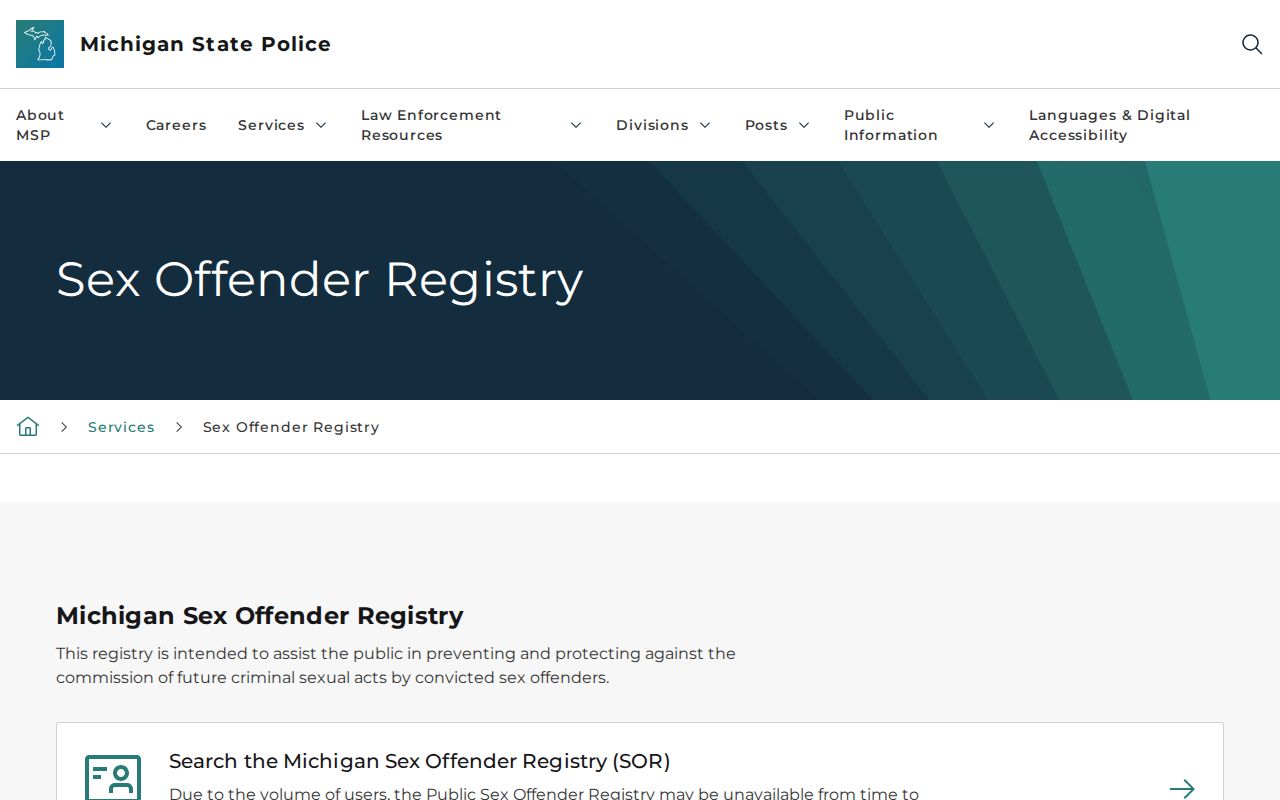
The state information page is the best place to confirm current registry policy when an Ionia County result raises a question about coverage.
Michigan Public Sex Offender Registry Searches
The official registry supports both person and place searches. Use only the fields needed, then check the result list for the correct profile. A same-name result is not enough to establish identity. Read the legal name, aliases, date of birth, photo, registration details, and location together before drawing a conclusion.
- Open Michigan PSOR and review its conditions of use.
- Choose a name search or the geographic search route.
- Enter the available facts and narrow by Ionia County when useful.
- Open the matching public profile and read its status, offense, and registration details.
The current PSOR search screen shows the name and geographic controls used for an Ionia County lookup.
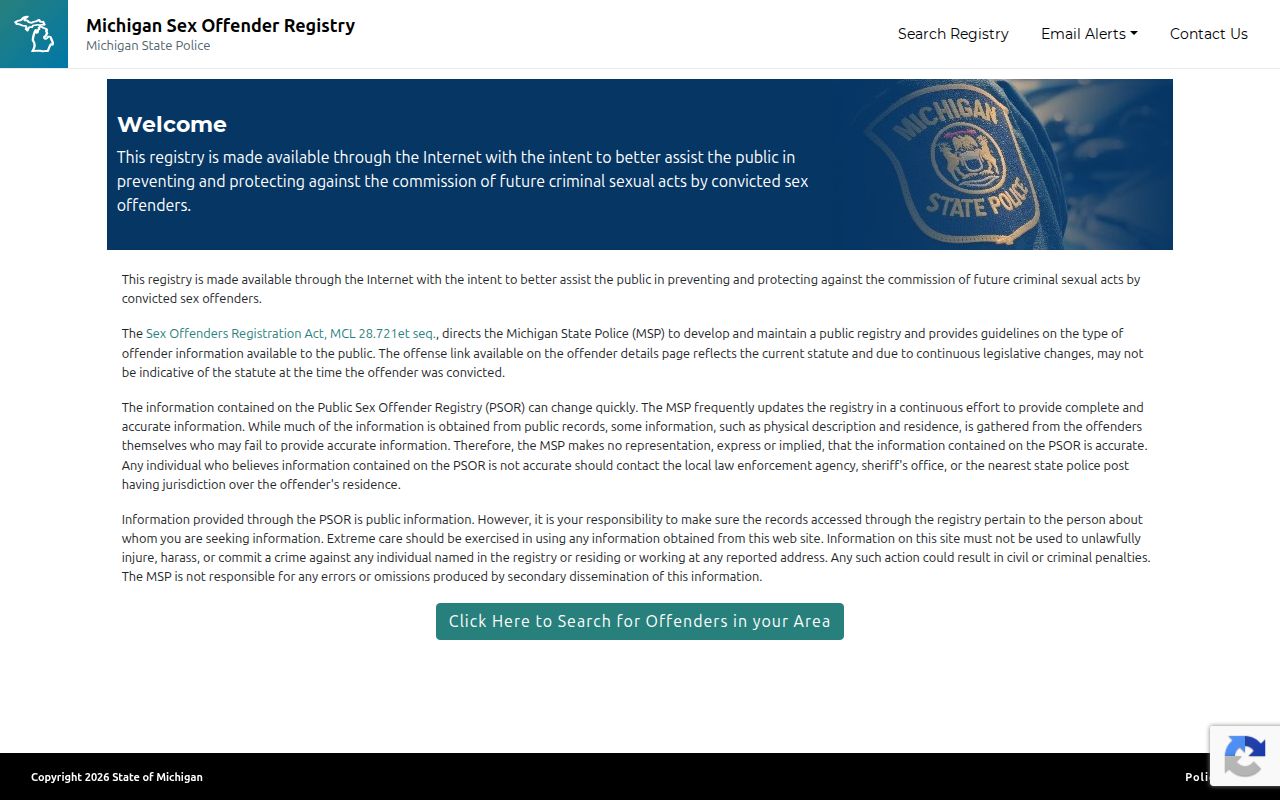
Those controls let a reader move from a broad county search to a narrower address-based review without using an unofficial people-search service.
| Field Label | Type | Required | Notes |
|---|---|---|---|
| Last Name | Text | Conditional | Main name-search field |
| First Name | Text | No | Narrows a name result |
| Address | Text | Conditional | Starts a geographic search |
| City or ZIP | Text or select | No | Focuses the location |
| County | Select | No | Choose Ionia for county results |
| Radius | Select | Conditional | Use current live options |
Ionia County PSOR and SOR
Michigan maintains two related layers. PSOR is the information that the law permits the public to see. The law-enforcement SOR includes nonpublic material used by authorized agencies. A person can therefore have registration duties without every underlying fact appearing in a public Ionia County sex offender search. The public interface should never be treated as a copy of the full law-enforcement record.
This split also shapes local questions. Police can receive a report about a suspected registration violation, but a member of the public cannot demand protected SOR data merely because a PSOR result seems incomplete. For the filed conviction, use the court that handled the case. Michigan State Police advises using ICHAT to identify the county of conviction, then asking that court for its public case file.
Registry Profiles: What They Show
A PSOR profile combines identity facts, location details, offense information, and the current registration status that Michigan permits for public display. Victim identity is not a public profile field. A profile may also list more than one address or category of location, such as a residence or campus. Vehicle facts and physical marks can help distinguish people with similar names.
| Name and Aliases | Legal name plus public prior or alternate names |
|---|---|
| Photo and Description | Photo, birth date, physical traits, and scars, marks, or tattoos |
| Registered Locations | Public residence, campus, and other covered address details |
| Offense Information | Listed offense, statute, and public conviction facts |
| Vehicles | Public vehicle information tied to registration duties |
| Registration Status | Registration number, status, tier, and compliance details that PSOR displays |
Read each label literally. A listed offense describes the qualifying case. It does not forecast conduct, and the tier does not measure a person’s current risk.
Ionia County Registry Email Alerts
PSOR links to geographic email alerts for changes near a selected place. This is a useful option for an Ionia County resident who wants updates without repeating the same map search. The alert service is tied to location changes reported to the registry. It does not replace a new PSOR review when precise, current facts matter.
Choose a location that serves the real safety need and keep the alert email current. A notice may prompt a fresh look at the official profile. It should not prompt contact with, surveillance of, or public claims about the listed person. Registry notices work best as one part of a calm safety plan.
Ionia County Registry Conviction Files
A PSOR entry summarizes the listed offense, but the court file gives the procedural record behind it. Michigan State Police recommends using ICHAT to identify the county of conviction, then requesting the public case file from that court. For an Ionia County conviction, the 64A District Court record may hold early felony events or a district-level disposition. The 8th Circuit record holds a felony after bind-over.
Look for the complaint, information, plea or trial result, judgment, and sentence. Those documents explain the adjudicated case more fully than a registry label. The Ionia County Circuit Court page identifies the courthouse route, while the County Clerk can address public copies. Protected personal data, sealed material, and victim information remain outside ordinary public access.
Registration Levels and Duties in Michigan
Michigan uses an offense-based tier structure. The statute assigns a tier from the qualifying offense and related rules, not from an individual prediction of future conduct. Duration can also change under statutory reduction, removal, or other lawful relief. Use MCL 28.722 and the current Sex Offenders Registration Act for exact definitions and offense placement.
| Tier | General Duration | Public Effect |
|---|---|---|
| Tier I | 15 years, subject to statutory rules | Public treatment depends on the offense and Michigan publication rules |
| Tier II | 25 years | Public registry applies to covered public registrants |
| Tier III | Life | Lifetime duties and public registry apply, subject to lawful relief |
Verification and update duties depend on the law and the person’s status. The public should not infer that a higher tier proves a current threat.
Missing Ionia County PSOR Results
A search can return no result for several lawful reasons. MSP identifies juvenile adjudication, death, nonresident status, a nonlisted offense, certain pre-October 1995 cases, court-ordered removal, set-aside relief, HYTA treatment, an expired duration, and specified nonpublic single offenses. Spelling, a past address, or registry downtime can also affect the path a reader takes.
Do not fill that gap with an unofficial claim. Check the name and place fields, try the county search, and use the MSP registry contacts for a coverage question. If the goal is to understand a known conviction, the Ionia County court case lookup can lead to the public docket and the clerk holding the file.
Ionia County NSOPW Offender Searches
County lines matter near neighboring jurisdictions or after a move. The U.S. Department of Justice National Sex Offender Public Website, or NSOPW, searches participating public registries across states and territories. It adds a cross-state layer, but it does not replace Michigan PSOR for the most direct look at Michigan profile fields and local geographic alerts.
The official NSOPW interface shows how a broader search can supplement an Ionia County registry review.
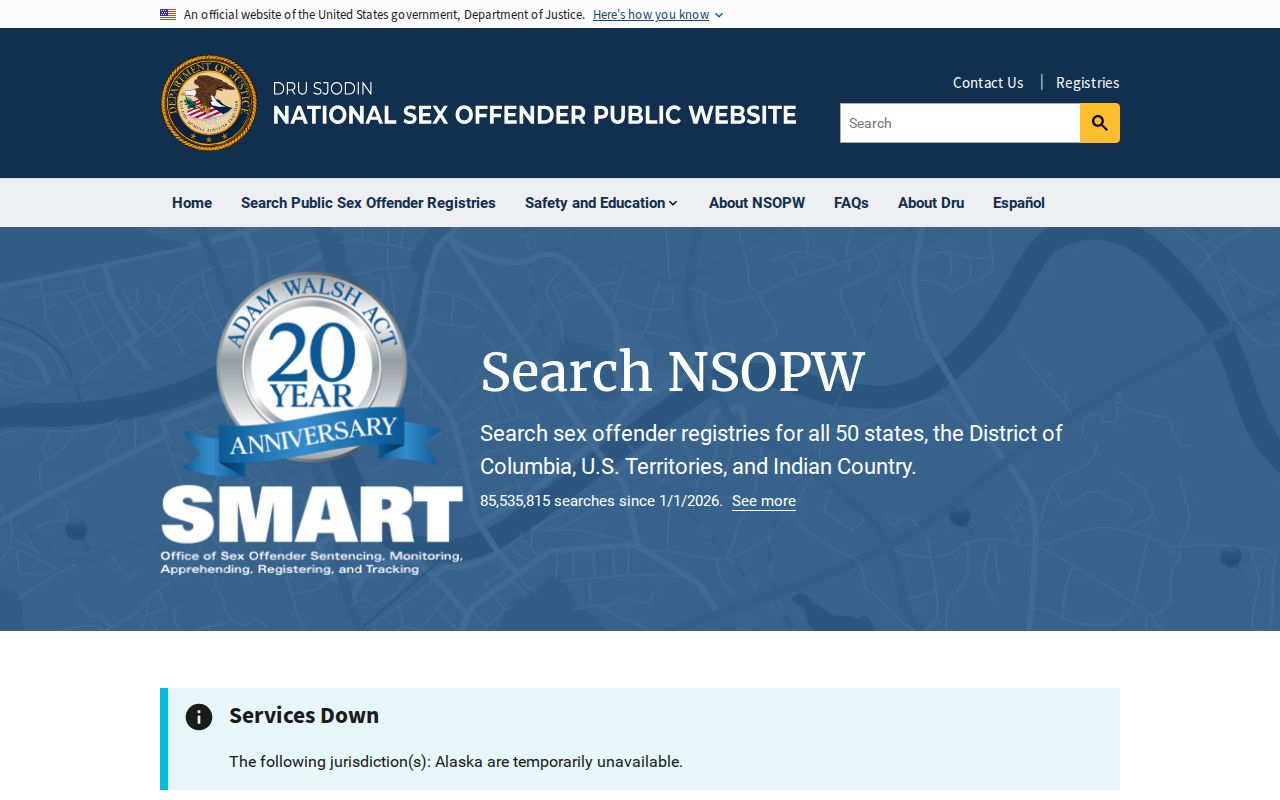
Use the national result to identify the source registry, then open that official jurisdiction’s profile for current detail.
PSOR Downtime in Ionia County
Michigan warns that the public registry may be intermittently unavailable due to volume. If PSOR does not load, wait and retry the official site. NSOPW can serve as a temporary cross-check, while the MSP SOR line can address registry process questions. None of those options justifies copying stale third-party data.
For a suspected registration violation in Ionia County, give local law enforcement the facts that prompted concern. For a known conviction record, request the file from the conviction court. Each fallback has a distinct role, and none turns a temporary outage into proof that a person is or is not registered.
Using Registry Information Lawfully
PSOR exists for public awareness and safety planning. It can support informed choices about family routines, neighborhood awareness, and when to contact police about conduct that appears to violate the law. It is not an invitation to confront a registrant or members of that person’s household. A profile also does not prove any new offense.
Registry misuse is unlawful: MCL 28.734 provides penalties for prohibited use of registry information. Do not threaten, intimidate, or harass a registrant or household.
When an Ionia County sex offender result raises an immediate safety concern, report the conduct rather than acting on the listing. For a nonurgent registration concern, use the MSP contacts or the local police agency with jurisdiction. Keeping the response tied to facts protects the community and preserves the registry’s public-safety purpose.